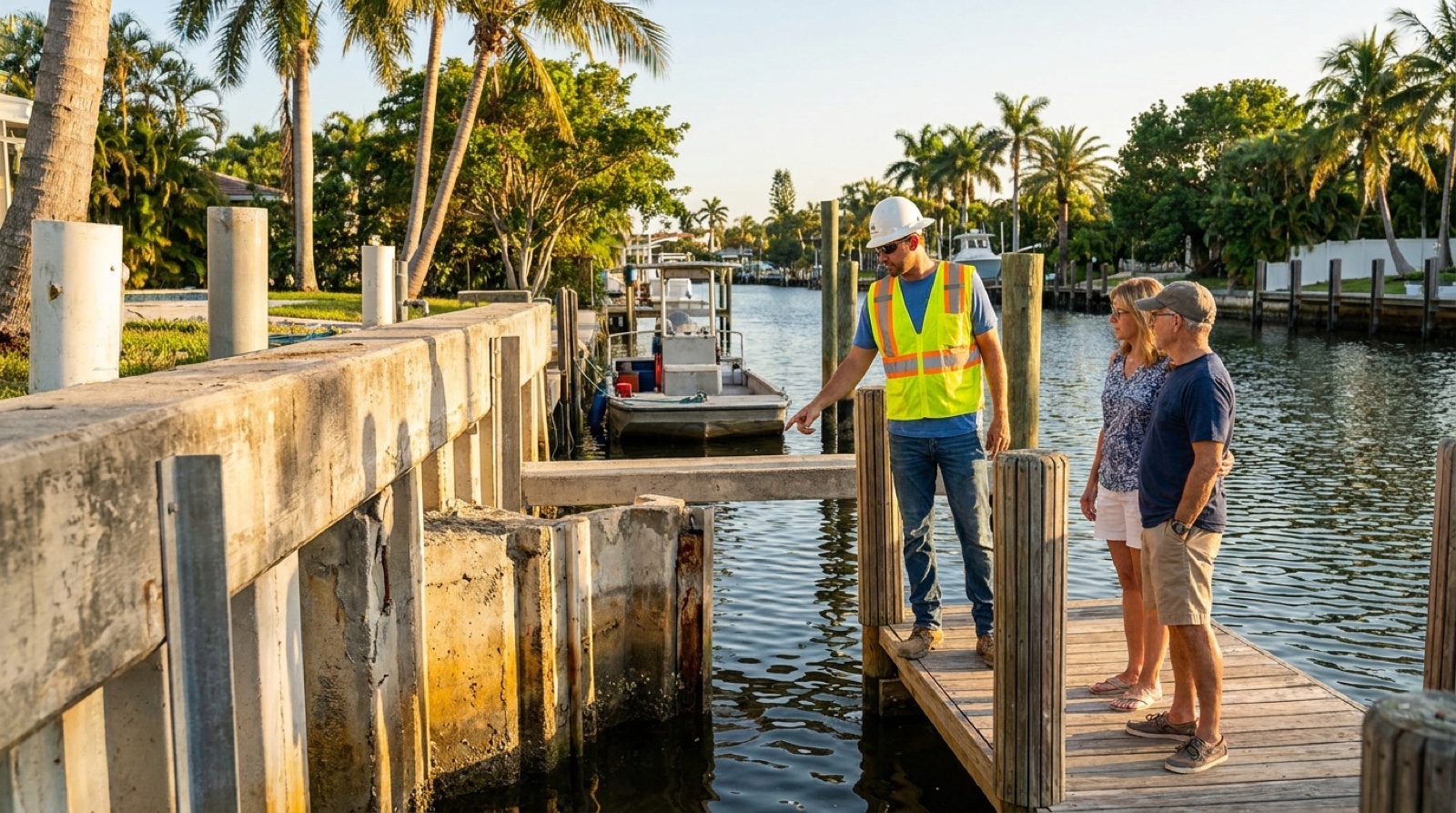
Start with license verification. Ask for the contractor's Florida license number, then check it yourself at the DBPR website before the conversation goes any further.
Marine construction in Lee County is not general handyman work. A contractor who cannot produce a verifiable license and current liability and workers compensation insurance should be off your list immediately.
License and Insurance Questions
Seawall work in Florida typically falls under a marine specialty contractor or general contractor license. Ask which one they hold and whether it covers the specific scope you need.
Then ask for a certificate of insurance sent directly from the insurance agency, not a PDF forwarded by the contractor. Certificates get edited, and expired coverage on your property becomes your problem.
- What is your Florida license number? Verify it independently at myfloridalicense.com.
- Do you carry workers compensation? If a crew member is injured on your seawall and there is no coverage, liability can land on the homeowner.
- What is your general liability limit? Barge work, excavation, and heavy equipment near a neighbor's property justify meaningful coverage.
- Are you the contractor or a broker? Some companies sell the job and subcontract everything. Ask who is actually on site.
Permit Handling
Almost every structural seawall project in Cape Coral requires permitting through the city, and many also touch the Florida Department of Environmental Protection or the Army Corps of Engineers depending on the waterway.
Ask directly who pulls the permit. If the contractor asks you to pull it as the homeowner, that is a warning sign that they may not hold the proper license.
A qualified contractor should be able to explain elevation requirements, setback rules, and how your cap height relates to NAVD datum. Companies that handle permitting and marine engineering coordination in house tend to move faster than ones that outsource it after the contract is signed.
Permit questions worth asking
- Is the permit cost included in the quote or billed separately?
- Who handles inspections and scheduling with the city?
- Will this project trigger a required elevation review against current NAVD standards?
- What happens to the timeline if the permit is delayed?
Scope and Method Questions
Two contractors can look at the same wall and propose completely different work. That is not always dishonesty, but you need to understand why.
Ask each one to explain what is failing and why their method addresses the cause rather than the symptom. A contractor who recommends full replacement should be able to explain why a targeted structural repair would not hold.
| Ask This | What a Good Answer Sounds Like |
|---|---|
| What is causing the failure? | Specific cause named, such as tieback corrosion, panel cracking, or soil loss behind the wall |
| Why this method? | Explains why foam injection, anchoring, or replacement fits the condition |
| What is not included? | Names exclusions clearly instead of saying everything is covered |
| How long will it take? | Gives a working day range and explains weather and tide dependencies |
If soil is washing out behind the wall, ask whether they perform void filling and erosion correction or simply patch the visible surface. Cosmetic patching over an active void fails again within a season or two.
For walls leaning under soil pressure, ask whether tieback and anchor restoration is part of the plan. A cap repair on a wall with failed anchors is money spent on the wrong problem.
Warranty Questions
Get the warranty in writing before you sign, and read what it excludes. Verbal warranty promises are worth nothing after a contractor changes business names.
Ask how long the workmanship warranty runs, what voids it, and whether it transfers if you sell the house. Transferability matters in Cape Coral, where waterfront buyers scrutinize seawall condition during inspection.
Also ask whether the company will still exist to honor it. A contractor with a decade of Lee County projects behind them is a different risk than one formed after the last storm season.
References and Local Track Record
Ask for three addresses of completed seawall projects in Cape Coral, Fort Myers, or Matlacha from the last two years. Drive by and look at the work.
Photos are easy to borrow. A wall you can see from the street, or better yet from the water, tells you more than any brochure.
Ask specifically about Hurricane Ian work. Contractors who rebuilt walls across Lee County after 2022 have seen failure modes that newer entrants have not, including storm damage repair on walls that looked fine from the yard side.
Red Flags That Should End the Conversation
- Large upfront deposit. Florida law limits what a contractor can collect before work begins on residential projects. A demand for half the job cost up front is a problem.
- No written scope. A one line quote with a price and nothing else gives you no recourse.
- Door knocking after a storm. Storm chasers work the canals after every hurricane and leave the county before warranty claims arrive.
- Pressure to sign today. Legitimate marine contractors in Lee County have backlogs. They do not need same day signatures.
- Cash only or personal check to an individual. Payment should go to the licensed business entity.
- Refusal to provide references. There is no acceptable explanation for this.
Get Quotes You Can Actually Compare
Ask every contractor to quote the same scope. If one bids a foam injection and another bids full replacement, you are comparing two different projects and price alone tells you nothing.
The most useful first step is an honest assessment of the wall. A documented seawall inspection gives you a baseline that every bidder has to respond to, which makes dishonest quotes easy to spot.
If you want a straight evaluation of your wall and a written scope you can hold a contractor to, reach out for a quote and we will look at it. We work canals throughout Cape Coral, Fort Myers, North Fort Myers, Matlacha, and Pine Island.