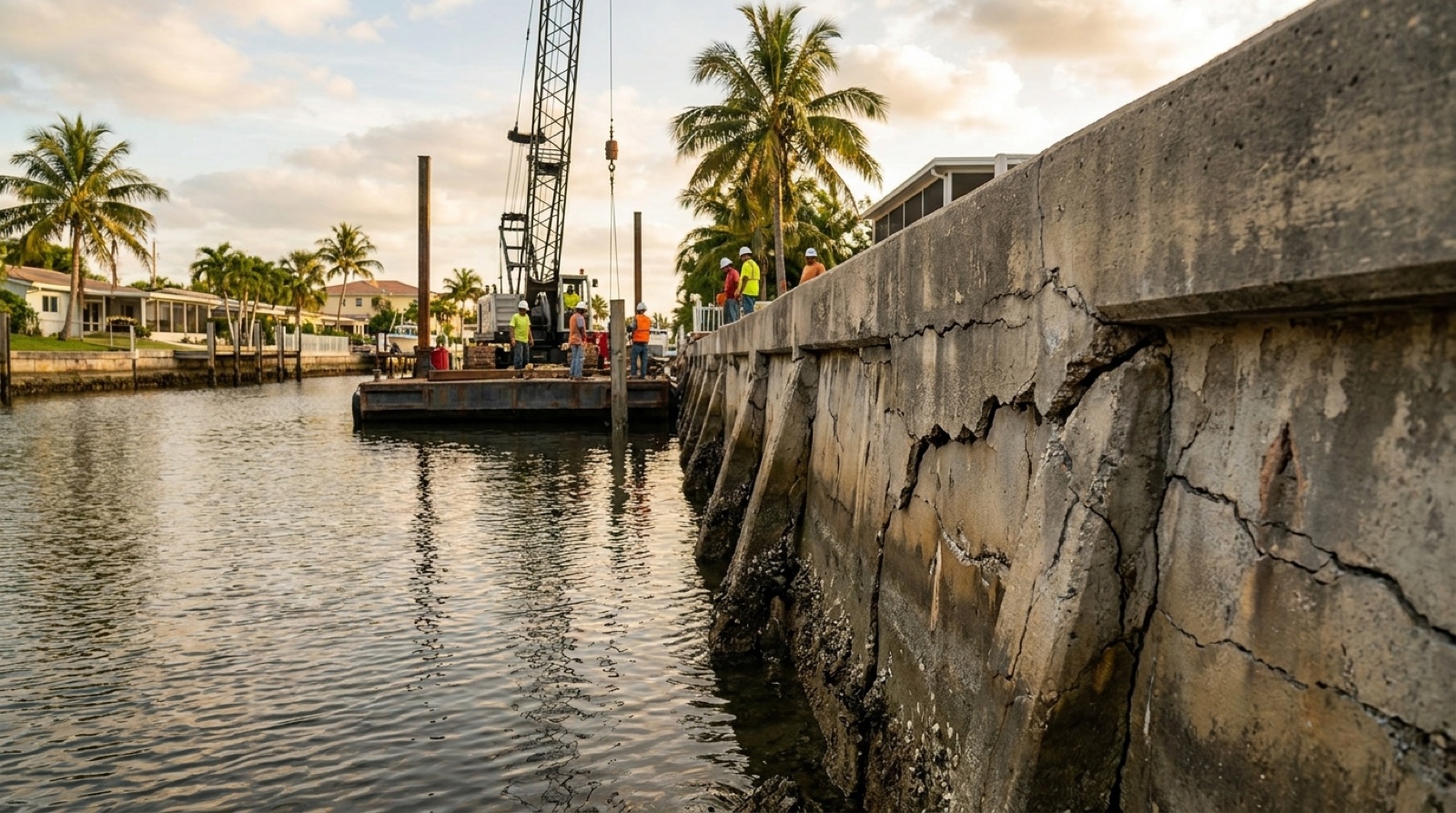
A failing seawall almost always warns you before it collapses. The trick is knowing which signs are cosmetic and which mean the structure is losing the fight against the water behind it.
Below are the seven signs we see most often on Cape Coral canals. If you spot any of them, get the wall looked at before the next heavy rain or king tide makes it worse.
1. Cracks in the Cap or Panels
Hairline surface cracks are common and often harmless. Wide, deep, or growing cracks are not.
Vertical cracks that run through a panel or a stair-step pattern along the cap usually mean the wall is under pressure or shifting. That is a structural problem, not a paint problem.
If the concrete is flaking off and exposing rusted steel bars, you are dealing with spalling. Our concrete spalling and rebar repair work stops that corrosion before it eats through the panel.
2. The Wall Is Leaning or Tilting
A seawall should stand plumb and straight. Any lean toward the water means the soil behind it is pushing harder than the anchors can hold.
Sight down the length of the cap from one end. A wall that bows outward in the middle or tilts forward at the top is failing at the anchor system.
This is one of the clearest signals that you need tieback and anchor repair or, in worse cases, new helical pile anchoring to pull the structure back into line.
3. Voids and Soft Spots Behind the Cap
Walk the top of your seawall and the yard just behind it. Spongy ground, dips, or areas that feel hollow underfoot mean soil is washing out through gaps in the wall.
These voids form silently under your lawn, pavers, or pool deck. Left alone, they grow until the surface above them gives way.
We fill and stabilize these spaces with polyurethane foam injection, which lifts and locks the soil back in place without tearing up your yard.
4. Sinkholes and Collapsing Ground
A sinkhole near the waterline is the visible stage of the void problem above. When enough soil escapes, the ground drops.
You might see a depression at the base of the wall, a gap opening behind the cap, or a section of seawall that has separated from your patio.
This is an urgent situation. If a hole is actively opening up, call our emergency seawall repair line at (239) 374-4848 before it takes more of your property with it.
5. Rust Staining on the Concrete
Brown or orange streaks bleeding down a panel are a red flag. That color is rust from the steel rebar inside the concrete.
When rebar rusts it expands, and that expansion cracks the concrete from the inside out. In our salt and brackish Lee County water, this happens faster than most homeowners expect.
Rust staining means the corrosion is already underway. The sooner it is treated, the more of the original wall you keep.
6. Erosion at the Base and Toe
Check where the wall meets the water. Scouring, exposed footing, or a growing gap at the toe means the water is undercutting the foundation.
Once the base is undermined, the whole wall loses support from the bottom up. On many older Cape Coral canals, we protect the toe with riprap and rock revetment to break wave energy and stop the scour.
7. Murky or Muddy Water Along the Wall
Clear canal water that suddenly turns cloudy near your seawall is telling you something. That cloudiness is often soil from your own yard washing through the wall and into the water.
If the water is murkier next to your wall than elsewhere on the canal, the structure is leaking sediment. It is one of the earliest signs, and catching it here saves you the most money.
What to Do When You Spot the Signs
One warning sign on its own may only need a small fix. Several together usually point to a system-wide problem.
Here is a quick guide to how the signs typically map to solutions.
| Warning Sign | Likely Cause | Common Fix |
|---|---|---|
| Cracks and spalling | Rebar corrosion, pressure | Panel and cap repair |
| Leaning wall | Failed anchors | Tieback or pile anchoring |
| Voids and soft ground | Soil loss through gaps | Foam injection |
| Sinkholes | Advanced soil loss | Emergency stabilization |
| Erosion at toe | Undercutting | Riprap revetment |
The honest answer for many aging walls is that repair buys time while replacement solves the root problem. When damage is widespread, full seawall replacement often costs less over the long run than repeated patch jobs.
If you are not sure how serious your situation is, start with a professional look. A thorough seawall inspection tells you exactly what is failing and what it will take to fix.
We serve Cape Coral, Fort Myers, Matlacha, Pine Island, and waterfront communities across Lee County. Reach out for a free quote and we will tell you straight whether you need a repair or a replacement.